
FM27 replaces tactical familiarity with a four-pillar effectiveness score. What moves the gauge, and why a complex tactic starts lower.
FM27 tactical effectiveness explained
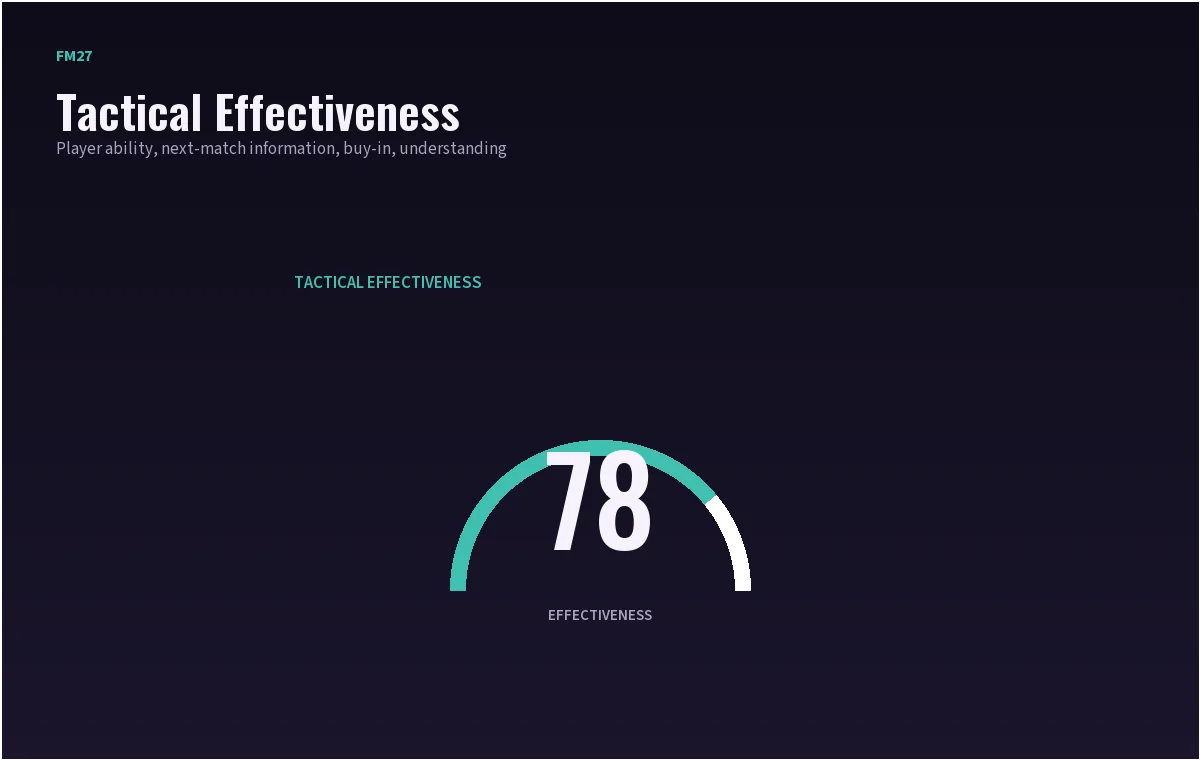
Tactical Effectiveness is the biggest system change in FM27. It replaces the old Tactical Familiarity bar, and it does more than rename it: the score is built from four inputs, it appears on three screens, and it responds to the opponent, the squad's mood and the training week rather than only to repetition.
If you understand the four pillars, most tactical problems become diagnosable. If you do not, the gauge looks like an arbitrary number that drops after a defeat.
What the gauge measures
Sports Interactive describes Tactical Effectiveness as an overarching system with four pillars:
- Player ability — whether the players can execute the roles and instructions.
- Next-match information — what you know about the opponent and whether the plan uses it.
- Player buy-in — whether the squad believes in the approach.
- Tactical understanding — how well the system has been trained.
Each pillar contributes to the score shown on the tactics screen. The same score appears on the training and recruitment screens, where it answers slightly different questions: can training fix this, and would a transfer fix this.
Pillar 1: player ability
Ability is not a single number. It is the fit between the role's attribute requirements and the player's attributes, plus the physical capacity to do the job for ninety minutes.
A pressing forward with 12 work rate will not lead a high press, however good his finishing is. A ball-playing centre-back with 10 composure will give the ball away under pressure, however good his passing looks on paper. The gauge notices.
The practical test: for each role, name the two attributes the job depends on. If the player is below the squad average in either, the role is costing effectiveness.
Pillar 2: next-match information
This is the pillar that changes week to week. The game tracks what you know about the next opponent — their shape, their key players, their set-piece threat — and whether your plan accounts for it.
You do not need to change the whole tactic for every match. You need to make one or two decisions that show the plan was prepared: a lower line against a fast striker, a narrower shape against a team that crosses, a specific marking assignment for a playmaker.
Scout reports feed this pillar. If you have no scout report, the pillar is weaker, and the scouting guide explains how to fix that.
Pillar 3: player buy-in
Buy-in is morale, relationships and belief. A squad that has lost four in a row will not execute a demanding press with conviction, and the gauge will show it before the results do.
Three things move buy-in:
- Team talks and shouts. Honest, consistent messages work. Repeating the same shout every ten minutes does not.
- Selection. Players who are dropped without explanation lose belief; players who are played out of position lose it faster.
- Results. Winning buys patience. A bad run makes every other pillar harder to hold.
You cannot talk a squad into a system it cannot play. Buy-in amplifies ability and understanding; it does not replace them.
Pillar 4: tactical understanding
Understanding is the training pillar. It rises when the squad trains the shape and the instructions, and it falls when you change both at once.
This is why pre-season matters so much in FM27. A tactic introduced in July has six weeks to bed in before the results count. A tactic introduced in November, after a bad run, has days.
The training module has match preparation sessions that target the next opponent and general sessions that target the system. The training guide covers the weekly split.
Why complex tactics start lower
Tactical complexity is calculated from the roles and instructions you use. More instructions and more demanding roles cost more understanding, and a squad with limited mental attributes takes longer to reach the same level.
The trade-off is deliberate:
- Simple systems start higher and cap lower. They are stable, easy to rotate and forgiving of injuries.
- Complex systems start lower and cap higher. They need time, intelligent players and a settled XI.
A lower-league side should treat complexity as a luxury. A Champions League side should treat simplicity as a ceiling. Most saves sit in between, and the right answer is to add complexity one instruction at a time.
Reading the gauge
The number is a summary, not a verdict. Three patterns are worth recognising.
High ability, low understanding. The players are good enough but the system is new. Train it, do not change it.
High understanding, low ability. The system is drilled but the players cannot execute it. Simplify the roles or buy for the roles.
Everything high, results bad. The plan is executable but wrong for the opponent, or the match engine is punishing a specific weakness. Check the next-match pillar and the set-piece setup.
Everything low. The squad has lost belief. Fix morale before touching tactics.
How to raise it quickly
- Freeze the shape for three matches. Every change resets understanding.
- Train match preparation against the next opponent. It is the fastest way to move the next-match pillar.
- Remove one instruction. Complexity is a budget; spend less and the squad executes better.
- Fix the weakest role. One player below the required standard drags the whole score.
- Use the recruitment screen. It shows whether a target fits the system before you buy, which is cheaper than fixing it later.
What it does not do
It does not make a bad tactic good. It does not guarantee results. And it does not replace watching the match: a high score with a structural weakness — no holder, no width, no runner — still loses to a well-drilled opponent.
What it does is make the game's feedback honest. If the gauge is low, the squad is telling you something. The tactics guide explains how to respond, and the formations page explains which shapes are cheapest to execute.
Sources
More Football Manager 27 Guides
The FM27 free agent list worth signing: 34 players without a club, their ages, positions and what each one still does well.
Manage in FM27's lower leagues: part-time contracts, free transfers, simple tactics, squad size and the promotion plan that survives League One.
Football Manager 27 costs £49.99, €59.99 or $59.99, with 10% off for pre-purchase. What the discount covers and what it does not.
Football Manager 27 releases on 10 November 2026. Here is how the global unlock works, when your region flips, and what opens earlier.
Set up FM27 scouting properly: assignments, scout attributes, recruitment focuses, report reading and the shortlist that finds wonderkids first.
FM27 corner routines, free-kick delivery and defensive set-piece setup, with a near-post routine you can build in five minutes.
Which FM27 staff attributes actually matter: coaching stars, workload, physios, set-piece coaches and the backroom hires that move the numbers.
Minimum and recommended FM27 PC specs, the laptop chips that qualify, Mac support and what to upgrade first if your machine struggles.